New Book!

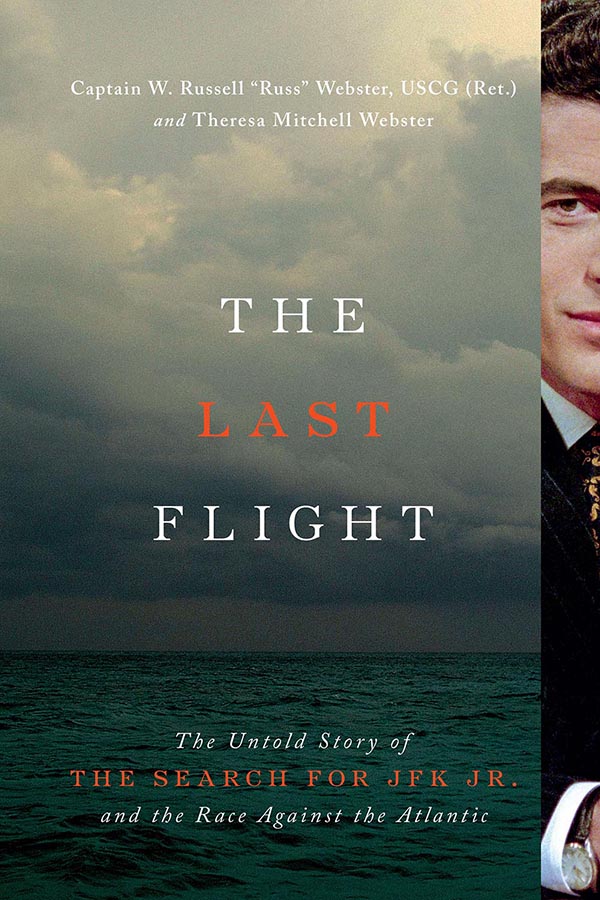
The Last Flight:

The Untold Story of the Search for JFK Jr. and the Race Against the Atlantic

On July 16, 1999, at 8:48 p.m., a small plane piloted by John F. Kennedy Jr., with his wife, Carolyn Bessette Kennedy, and her sister, Lauren Bessette, aboard, plummeted into the Atlantic seven and a quarter mile southwest of Martha’s Vineyard. The National Transportation Safety Board would later conclude that spatial disorientation by Kennedy was the cause of the tragedy. The moment the plane was reported missing overnight on Friday, the Coast Guard launched the largest search for private citizens aboard a small plane in U.S. waters in American history in partnership with the FAA, the National Oceanic and Atmospheric Administration, and later, the U.S. Navy.  The search and rescue mission for, and respectful recovery of, the deceased and the plane’s wreckage, proved to be one of the most complex, unprecedented, and closely watched multi-agency operations along with numerous local and state agencies like the Massachusetts Environmental Police and the Massachusetts State Police.  


In The Last Flight, retired Coast Guard Captain W. Russell “Russ” Webster—the officer who coordinated the search mission and the then-Group Woods Hole Commander—and historian Theresa Mitchell Webster, provide the first-ever accounting of the intense operation that captivated the world. Drawing on first-hand accounts, official government records and updated research, the book offers a fresh and compelling narrative of leadership, military professionalism, and human dedication during a sorrowful mission which resulted in the respectful burials-at-sea of the deceased. 


The Last Flight may be pre-ordered on Amazon. The book will be published October 13th.

Order Now: Amazon

New England’s Lifesaver: Coast Guard Legend Master Chief Jack Downey

What People are Saying

“The book is important because it humanizes the uniform. Too often, the Coast Guard is known only by its institutional presence… but in New England’s Lifesaver, we meet the person behind the uniform.”

Review by Jason Zuidema (NAMMA)

Order Now: Amazon | History Press


A legendary Coast Guard hero, Jack Downey saved more than 700 lives in 5,000 daring New England rescues.

New England's Lifesaver - Captain Jack Downey

During a storied forty-two-year Coast Guard career, John “Jack” Downey, a Rhode Island native, would be credited with saving more than 700 mariners in distress during five thousand rescues in New England waters. Across thousands of missions, Downey and his crews rescued 11 passengers from the ferry Sea Comet and 108 elderly passengers from the Pilgrim Belle, and he participated in search-and-rescue efforts for the air crashes of JFK Jr. and EgyptAir 990.

A natural-born leader, Downey was named the Coast Guard’s first Ancient Keeper for his lifetime commitment to keeping people safe on the seas.

Authors Captain Russ Webster and Captain Michael Cicalese recount the extraordinary career of this lifesaver and how he honored the old ways of the sea while serving in three different government departments.

Order Now: Amazon | History Press


Featured Article

The Long Blue Line: The loss of Morning Dew and genesis of Rescue 21

The Long Blue Line

Reflecting on the tragic 1997 Morning Dew incident in Charleston Harbor, the U.S. Coast Guard faced critical failures in its rescue communication systems. The distress call mishandling, attributed to outdated technology, human errors, and procedural lapses, prompted an 18-month search and rescue analysis. The Coast Guard’s National Distress System (NDS) deficiencies led to a call for a new communication solution. The subsequent implementation of the Rescue 21 (R21) system marked a transformative upgrade, addressing limitations of the NDS with advanced technology, improved signal identification, and enhanced coordination. Having witnessed the evolution from the 1997 incident to the full deployment of R21 in 2017, it’s clear that technological advancements and procedural changes are vital. Challenges persist in adapting to modern communication trends, with a decline in radio-initiated rescue calls and a rise in phone and smart technology notifications, emphasizing the ongoing need for innovation in near shore rescue communications.

READ MORE

More Recent Blog Posts